Thursday, 24 December 2015

News at Christmas

After a few days in India I had no idea what had been happening on Strictly, and the whole billboard of soap-opera stars and celebrity chefs had quickly disappeared from the usual gossip of journalism.

At home in Lincoln, I’ll occasionally watch Jon Snow deliver Ch4 News, but for years now I’ve gleaned most of my updates from Facebook postings by The Guardian, Huffington Post, The Independent, Al-Jazeera and Russia Today. 
How else could I ever learn the other side of the story?
The skate-boarding dog
Apart from skateboarding dogs and musical chimpanzees, the US media channels are dominated by their Presidential candidates, exposing the full horror of the US electoral system. I really cannot bring myself to write about that, but there is a different topic, a little closer to home, that shows heart-warming humanity and empathy.

Just occasionally, something truly shocking slips onto the screen of my laptop, like yesterday, when I read that so far this year, 1 million refugees and migrants have crossed from Asia and Africa to Europe via the Mediterranean or the Aegean; - at least a thousand more dying in the course of the sea journey alone.

As I started following the links at the foot of the article, I picked up inspirational stories like a group calling themselves Dirty Girls. I don’t know how many girls they are, but they operate a free laundry service on the island of Lesvos, which is the first European destination for thousands of travellers. Refugees and migrants bag up their dirty laundry and leave it at a drop-off point, then collect it, clean and dry, a day or two later. 
Volunteers, giving something that’s needed.

Then there’s the team of IT nerds from the UK who have installed free Wi-Fi in the Jungle in Calais. In the first hour after switch-on, the system handled over 1,000 emails. Anyone whose children have gone travelling will know the importance of that first “arrived safely” email or Skype call. The tekkies now plan to take what they have learned in Calais and produce a similar installation on Lesvos. 
Volunteers, giving something that’s needed.

Back home in Lincoln, “Compassionate Lincoln” are collecting socks, sweaters and back-packs for the cold and ill-prepared travellers; I had a big clear-out before I left, so someone now has my scarlet fleece gilet, and someone else is now sporting my knitted woollen bobble-cap from the 60s.
Just giving something that I no longer need.

I have talked about the refugee/migrant crisis with colleagues here, in the monastery-ashram, and I am horrified at the attitudes of “well, we haven’t got room for them.” This is a mentality that I might expect in the Daily Mail, but not here. I am shocked that people who come to meditate in a monastery for Christmas could hold such opinions. In times of crisis, there is always room if the attitude is right. It’s that “budge up; make room!” mentality that is prepared to sacrifice a little of our own comfort to make room for those less fortunate.

I am reminded of the story about a guest-house proprietor, years ago, shrugging his shoulders when confronted with an unmarried pregnant teenager and her fiancé. He claimed all his rooms were booked, and let them bed down in an outbuilding, where, so the story goes, they used an animal feeding trough as a cot for their new-born son.

I wish all my friends, family and followers a warm, comfortable and Happy Christmas with all who are close to you.

Tuesday, 22 December 2015

On becoming an Oblate of Shantivanam

When I was here last year, they announced a fund-raising scheme: “Friends of Shantivanam.” One was invited to commit to making a modest regular payment to the ashram/monastery to help fund expansion of the activities in the local community. Accordingly, I switched one item of my charitable giving. For years I had been giving £5/month to Christian Aid, by way of acknowledging the fact that Christian Aid had paid my £199 air-fare when I first flew to Kenya as a VSO in 1962. I decided that I would now pledge a similar monthly amount to the Father Bede Griffiths Trust for the work of Shantivanam.

I have regularly followed Shantivanam online, and as I navigated the complex tabs of the website, I somehow stumbled on the fact that there was to be a “Gathering of Friends and Oblates” at the ashram in December. This was the first time I heard the word “oblate”. 
Saint John's Parish Church Harrow Greenhill where I was confirmed ages ago

Age 12 - Confirmation Classes

I remembered the phrase “alms and oblations” from confirmation classes, - something to do with making a personal and financial commitment to the Church, in exchange for the sacramental Grace of the Eucharist. Imagine a group of pubescent boys and girls struggling to absorb this kind of theological jargon, together with listening to a rather shy deacon skirting around issues of adolescent sexual purity. Yes, confirmation classes were a window on a whole new world, and the window opened wider, week by week – mostly outside the confines of the confirmation classes.

That deacon could have been the source of a wealth of forbidden knowledge to us, but he played a straight bat, and all I now remember about oblations was that this was a posh word for the money in the collection plate.  I tried to make an etymological connection between oblations and oblate, and though the logical link could perhaps be to voluntary human sacrifice, that didn’t really fit the Middlesex liturgy of St John’s, in Harrow. Consequently, sometime earlier this year, I started Googling and delving into Wikipedia, to try and clarify the function of an Oblate.

I soon discovered that becoming an oblate is a way of increasing one’s connection to a monastic group, while remaining in normal society, and not relinquishing any of the trappings of family, marriage, profession etc. It involves a form of commitment to the principles of Benedictine life, but does not impose specific demands in terms of daily services, etc. 

Sacrifices

While in some areas of my life I have struggled to make disciplined commitments (I struggle with the idea of almost any kind of physical exercise and exertion) there are other areas where I find I can take on challenging personal impositions. I have forsworn alcohol several times in recent years, most recently going “Sober for October” and raising money for charity by doing so. The Oblate commitment at Shantivanam is different, however, because it is broader and makes a more general demand. Shantivanam  Oblates are not necessarily Christian; but they do commit to living in accordance with the Rules of Benedict. “This moderation manifests itself in the use of goods of this world, an increasing concern for their neighbour and in the way they temper and direct their desires.” Oblates of Shantivanam must include study and meditation in their daily life, and must be open to the spiritual values and cultural traditions of religions other than Christianity. They must live a life of detachment and, in all aspects of their life, they must work for peace.

There were three of us who made our commitment on December 17th and I found myself reflecting on how many times in my life I have actually had to take on a formal pledge. I think the first time would be when I became a “Wolf Cub” (Cub Scout) and had to hold the totem pole while I made my Boy Scout promises. When I became a full member of my Bible Class as a young teenager, I declared my belief about the Bible being the “whole and entire word of God.” I was none too happy to declare that then, and I certainly could not swear that belief today. Since then I have taken marriage vows, signed credit agreements and mortgage papers, made a declaration to obtain a passport, but when I thought about my declaration to become an oblate, it felt like one of the most important commitments I had ever made.

For one thing, this was not an agreement binding me to a deal with any external institution; this was very much something I was doing for myself, and all that would hold me to it –would be me and my conscience.

Now, in the coming months, I shall just have to see what my word is worth.

The Birthday of Bede Griffiths

Celebrating a special person's birthday

Father Bede Griffiths, arrived in India as an Anglican priest from Sussex. In time he converted to the Roman Catholic tradition and led the ashram/monastery here at Shantivanam into the Benedictine community. For 25 years, from 1968 to his death here in 1993 he built up the community, and every year his birthday is celebrated here on December 17th.
It was a happy day, treated as a Feast Day; so we all feasted in traditional manner. The diet is 100% basic vegetarian, and after a while the addition of so much as a biscuit creates a stir of excitement amongst the inmates, ( – I mean guests.) 
We sit on the floor or on low stools for all meals - and take turns serving

The birthday celebration started with the addition of savoury chilli doughnuts as an extra to the breakfast menu of steamed rice pancakes and coconut sauce; at lunch we had a number of additional vegetable dishes to accompany the rice pilaff, and after the evening meal, there was a special folklore performance.
Now, we’ve all been on a package holiday at some stage in our lives, and we’ve all been on a Folklore Evening, haven’t we? The courier ushers everyone into a coach to be whisked off to a remote hostelry in the mountains, where we all perch on plastic chairs for a seemingly endless display of twirls and shuffles to the accompaniment of an accordion and assorted tambourines, bells and maracas. It could be Portugal, it could be Croatia: it could be Tunisia. Wherever it may be, it’s the sort of entertainment that makes one long for Morris Dancing. . . . well, maybe not quite that, but one does wonder why countries attach such importance and pride to what are often little more than incomprehensible prancing !
Happily, the performance at the ashram was quite delightful. In this remote community, a couple of miles from the dusty village of Kalithulai (if you Google Maps, you’ll see it’s a pretty tiny sort of place,) we were to be entertained by students from the local Dance Academy.  They were a shy little group of girls, but they made a tremendous effort to deliver a good show, and they deserved our loud applause for the entertainment.  It was traditional, with all the neck-swivelling and strange postures we’ve seen in Bollywood movies (- you haven’t?. . . . well, you ought to – just for the experience!)

The troupe did well, though I have to confess I didn’t last the show. My sleep-apnoea is presenting problems since my sleep-machine burned out on Day 3 of my trip, and I just hope that my Darling Daughter manages to courier the replacement from the NHS in the UK without any further complication. Then all I have to worry about is Indian Customs clearance. At present I am trying to sleep propped up with extra pillows, and though I awake quite confident that I have slept well, I am then likely to drop off without notice at any time in the day. I fell asleep after the coffee-break this morning, right through lunch and woke wondering what day it was.
Now I fear I shall never get to sleep tonight and will spend my evening slapping mosquitos and seeing the little splat of blood that they stole from me. 
No, dear readers, I am not afraid of all those horrible tropical diseases; everyone here is a shining model of health, and I intend to stay robust in health. 
One thing you have to agree on -  I am nothing if not robust !

Thursday, 17 December 2015

Settling in

I arrived at Shantivanam 24 hours in advance of the start of the Gathering, so that I could relax after my journey and catch up with people I might know. 

I found just two English aficionados, and no other familiar faces amongst the visitors – but a wreath of smiles from the Prior, Brother Martin and the other brothers, fathers and sisters of the community, most of whom I knew from lsat Christmas here. 

It was a warm and genuine welcome, and the rigours of my journey were soon forgotten.


My accommodation is simple and perfectly adequate: a metre-wide bed with mosquito net, a desk, a cupboard, then there’s a wet-room off to one side, with a large mirror, toilet, shower, washbasin and shelves for toiletries. “Shower” in India generally means a shower-head located somewhere on one of the wet-room walls and aimed to the floor. Then there’s a tap to fill a huge bucket, which has a hand-jug hooked on the rim.

The traditional showering procedure is a variation on the “Ice-Bucket Challenge.” You fill the bucket, then dip in the jug and pour a steady flow of jugs of water over your head and body. Now that I am used to the process, I love it. Across Asia there is a general aversion to the idea of washing in baths – soaking in your own dirty suds is considered most unhygienic.
I was chatting to fellow Englishman, Michael, whom I knew from last year, and who is the acting “Guest-Master” again this year. He was saying that the Indian guests are becoming increasingly demanding of the standards of the ashram, because the growing number of quality tourist hotels across India over the past decade has raised everyone’s expectations. He said that many Indian visitors take a very poor view of the primitive facilities at Shantivanam, while the French, Italians, Spaniards, Germans, Brits and others have no problem with lack of glitz and glamour – in fact, I think we like to feel it makes the Indian Experience all a bit more real.

Apart from upgrading the en-suites, the estate is, as last year, alive with renovations and expansion.
Weaving palm fronds into roofing panels
Palm roofing panels drying in the sun to harden

Dining table lashed to two stepladders to facilitate high-level working - don't tell Health & Safety !

 The old Jail-bar windows of some of the older accommodation huts are being replaced with shutters and glazing; some of the traditional palm thatch is, sadly, being replaced with the less aesthetic corrugated “tin” roofs, and there is gleaming fresh paint everywhere. The colour scheme continues to be what we in my family used to call baby-sh*t brown but this colour does have the benefit of blending in with the active vegetable allotments and lush foliage everywhere.
Corrugated roof panels being painted regulation "Baby-sh*t Brown"
The timetable is unchanged, starting at 5.30 in the morning, though I confess I have never made it to the early morning meditation. Morning chanting and Mass is at 6.30, but I skip this on most days as I do not feel any benefit from an hour-long Eucharist service that is mostly unintelligible. I always go to Midday and Evening Prayers in addition to the early evening meditation.
I am sad that the acoustics of the chapel are so poor. The circular design of performance buildings always challenges an architect – hence the giant mushroom-shaped sound baffles hanging over the orchestra at the Royal Albert Hall. Before these were designed and installed the sound quality was appalling. With daily readings here from the Koran, the Sikh scriptures and the Hindu Bhagavad Gita – in addition to the Bible – I would love to hear and think about what is being read, but with or without my hearing aids, the feedback and muffled echo, combined with the fairly heavy Indian-English accents defeat me, which is another reason I generally avoid the early morning service.

This December “Gathering” is the first time the Prior has invited friends of the ashram from around the world to meet and discuss.
The Prior chairs a session discussing the principles of Shantivanam

We have had sessions when individuals have recounted their life-journeys, and we have had sessions when Brother Martin has taught about the vision and heritage of Shantivanam. We have also had open discussion about our own thoughts and ideas for the future. People have come from Brazil, Canada, USA, South Africa, Kenya, Italy, Germany and the UK as well as various states of India. Two or three of the participants have known the ashram from its very early days and are very emotional when they talk about the charismatic personality of the late Father Bede Griffiths, who nurtured Shantivanam from its fledgling start to the thriving community it is today.

Brother Martin is in no way charismatic, but speaks from a broad and well-honed intellect, touching on themes that I have been finding time and again over the past couple of years in the seminars and conferences of Progressive Christianity. His theme this afternoon was Liberating Christ from Christianity, which echoed a book I was reading last month: Rescuing Jesus from the Church. I don’t think many people across Britain and elsewhere realise just how much radical thinking is going on behind the stained-glass windows, even if the public see little of such radical thinking when it comes to attitudes to women and sexuality.

Maybe this doesn’t sound like your kind of holiday, but I am simply loving it, – even if the bed is wooden boards, with a meagre two inches of foam mattress. The next step is to take my involvement one stage further by becoming an "Oblate" - a class of secular affiliation to the community here in India.

Sunday, 13 December 2015

The Journey and Arriving

The genial Father Pinto was completing my tourist registration declaration when I mentioned that I was expecting a package by courier. He reached down beside his desk and, with a twinkle in his eye, and handed me a small box bound up with brown parcel tape.
You mean this one,” he smiled, and I was overjoyed to get my hands on the replacement charger for my laptop.
Even though I have no internet access in my room, I can at least sit here and do the majority of my blogging, emailing, and general writing, in off-line mode. Later, I simply transfer my off-line draft to the Blogspot website and add the photos.
Ernakulam Junction is a busy station
Ernakulum station the previous night had been a less frenetic version of the kind of Indian railway station portrayed in films. The entrance area was crowded with families picnicking on the grubby floor or sleeping on their bundles of luggage. It’s a sort of mass “Waiting for Godot” scenario, and one wonders whether some of the apparent travellers live in a permanent state of suspended transit, waiting for their destination to be announced so they can escape the tyranny of railway purgatory.
I wove a path between them and staggered (weighed down by my back-pack) up the three flights of stairs to the bridge that stretched over the platforms, high above the power lines. I was taking the train from its starting point of origin, so there was no rush to clamber on and frantically search for my reservation. This was just as well, once I realised what “3AC” on my ticket actually meant. “AC” is air-conditioned class, and “3” meant 3-tiers with 6 to a compartment, very much the same as the couchettes that were the mid-priced option for crossing Europe in my student years.
Sliding into the bottom couchette place would have been one thing for the Henley-fit oarsman I once was, but at my present age and size it was rather like trying to store plump Teddy Bears on narrow bookshelves. Thank God I had the bottom bunk, or I would surely have come crashing down with an almighty thud. However, apart from the size limitations, it was most civilised, with crisp, freshly laundered sheets and pillowcase, a blanket and a fluffy towel, all included in the £4.20 I paid for my overnight trip across the sub-continent. At precisely ten past ten, the train gave a very slight shudder and crept out of the station, quickly settling into the regular rhythm that is reliably soporific on long journeys.
At eight next morning, there were auto-rickshaws waiting at Kulithalai station, and I paid the standard 80p fare for the 3 or so miles to the ashram.
You know how it is that sometimes, you take a step into a different space, and you could be changing planets. That is something of the sensation at Shantivanam. The community was buzzing. A 20-strong group, mainly of Americans and Europeans, were making their way from their accommodation, along the footpaths towards their waiting coach. The castors of their sleek, multi-wheeled shell suitcases struggled to cope with the thick dust of the dry paths, so that the unfortunate travellers had to sledge their luggage along. 
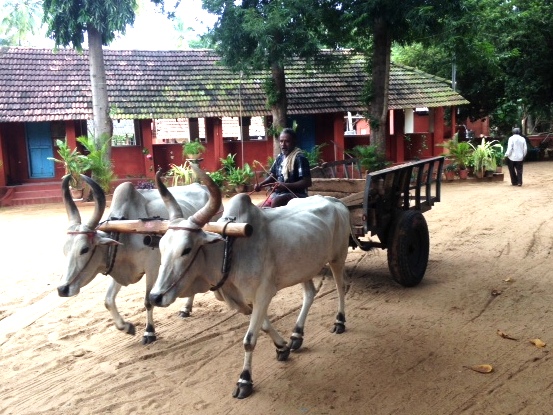
The ox-cart delivers building materials
They were an intriguing lot, middle-aged and beyond, and typical of the unusual groups you come across from time to time in this part of the world. South India is full of interesting international experiments in communal living, searching for a new spiritual solution to age-old human problems. These latter-day pilgrims were off to study another ashram nestled in another dusty Indian village.

So I arrived to join another intriguing group from around the world, also searching for a new spiritual solution to age-old human problems. But I had a back-pack: not a wheely-case, and I felt really good about that.
My Christmas retreat

Thursday, 10 December 2015

The perils of globe-trotting with technology

We have a problem

Early-morning view from my window
The first upset was Radio Lincolnshire. We were going to do a live interview, which I thought would be about my experiences at the Ayurvedic Clinic. I had prepared all my notes and we had achieved a quality voice link-up through FaceTime, but 5 minutes before we were due to go live, they emailed to say they'd changed their mind about the subject. The media sometimes act like this, and you just play along with it and look for another opportunity, - no point in objecting.

Things then started to deteriorate, when an electrical surge played havoc with my plans. Monday night was stormy. Ear-shattering thunderclaps and frequent brief losses of the electricity supply.
Next, the charger for my laptop gave a succession of loud cracks and the air was filled with the pungent smell of an electrical short-circuit. There must have been some sort of voltage surge. I quickly pulled out the plug,noted that the charger was warmer than usual to touch, and would clearly have to be replaced.
Using some of the remaining battery-life on the lap-top, I tracked down the appropriate device on E-Bay India, and by next morning had it on order, thanks to the kind cooperation of my host here and his Rupee credit card. 

But it wasn't all resolved, because when I went to bed on Monday, I noticed the burnt small was still lingering. The electrical surge had burnt out my CPAP machine which lets me sleep peacefully every night, despite having suffered for 20-odd years from Obstructive Sleep-Apnoea.  
Having been used to a forced current of air in my windpipe every night for 20 years, it was a strange and disturbing sensation to try and sleep just with my head on the pillow. Monday night was difficult; Tuesday was better but by Wednesday, I was almost dropping off normally. I have been negotiating with the NHS to courier a replacement, but I am not sure whether that will happen this side of Easter.

Apart from these distractions. . .

The cuisine is nothing to write home about!
I have had a week of fierce massages and soothing herbal baths, a strict minimalist vegetarian diet and plenty of time to think about the week ahead.

I have one more day of treatment here, then I take the night train tomorrow, across from Kerala into Tamil Nadu. I plan to arrive at the monastery/ashram in time for breakfast.

We shall be an international mix of laity, monks and clergy, gathering for four days of to meet up and discuss what ideas we can share about the unique community model developed at Shantivanam.

And then there's Christmas, which was hugely enjoyable last year, but anything could happen before then!.

At least I should have my laptop working. Writing this on the old communal machine in the recreation room has been challenging,


Sunday, 6 December 2015

Landing in India

Cochin airport has one important claim to fame: it is totally solar-powered. Everything from traffic control to air-conditioning runs on green energy, generated by the adjacent field of photovoltaic panels.

It might lack the glitzy glamour of Heathrow's mega-terminals, but that's no great loss. The operation runs smoothly and efficiently with a warm welcome and friendly service throughout immigration and customs. 

International arrivals at Cochin airport
There is a quaint touch at the immigration desks as the officers ask you to smile at the souvenir toy elephants that house digital cameras to record your arrival. 
Somehow that seems less offensive than the cold stare of the "Homeland Security" officials at Logan Airport in Boston, who glare it me as they take my fingerprints each time I fly to America to visit my son and my grandchildren. By contrast there is a real warmth to the welcome that greets me when I arrive again in Kerala.

Cochin Metro

Delhi's Metro serves thousands of local commuters
When I travel in Asia, I am always excited by the emphasis local government puts on looking to the future. Transport planning is always a high priority. Would that we could embrace and accept such ideas in Britain. The plan for the M11 motorway was that it should continue northwards from Cambridge, over the Humber Bridge and link up as the prime route from London to Scotland. Today, that just seems pie in the sky!

India has plans for Mass Rapid Transport Systems to create a world-class infrastructure all over the sub-continent. Delhi and Kolkata already have Metro networks and the master plan envisages schemes for 12 cities across the continent.

Work is progressing fast on the Cochin overhead MRTS
The foundation stone for the Cochin system was laid in September 2012, and since then I have been coming to Kerala regularly and have been amazed by the speed of progress.
First several key commuter roads were widened, and then the work started to build an overhead track.
The first service is planned to commence in 2016


Cabs & Rickshaws!

When I first visited India in 1971, almost the only model of car on the road was the Hindustan Ambassador, a locally produced marque based on the British Morris Oxford, and which dominated the market until well into the 80's. It has become something of a classic, and several versions were manufactured until production finally ceased in 2010.

In London, the Vintage Ambassador is the only appropriate transport for a FlowerPower Hippy wedding
Bicycle Rickshaw - now a rare breed

For many years, the bicycle rickshaw was the general means of transport for short distances. In my last trip, earlier this year, I searched in vain for such a classic means of getting around town, but soon realised that the Auto-rickshaw has virtually replaced the man-powered version in Kerala.

The ubiquitous Auto-Rickshaw
The auto-rickshaw is everywhere in Asia. It has won the hearts of thousands of tourists in Thailand, where it is generally known by the onomatopoeic name of a "tuk-tuk"

In India auto-rickshaws are officially licensed to carry a maximum of three people, but you will often see them loaded with entire extended families.


The tariff is always negotiable, but here are the basics, in UK currency:

Per Kilometre   10p
Waiting per 15minutes   10p
Minimum Charge    20p


The next generation of auto-rickshaws has been developed by the industrial giant TATA (who also own Jaguar and Land-Rover in UK.) The 4-wheel Magic Iris  shrewdly targets the "Last Mile Public Transportation" opportunity with a smart and economic vehicle that retails for under £2,500. 
I went in one for the first time yesterday, and can see how this vehicle will succeed in the Indian market. It feels like a proper car, stable and secure, - and there is headroom, which is a real bonus for someone my height. The rate card remains the same, with the minimum charge of 20p.


And now I must think about what I might say on BBC Radio Lincolnshire tomorrow morning, when they have booked me to phone in and talk about Detoxing - Indian Style.

I just hope we can get the audio connection working!